
Regular blog here, 'microblog' there
Many of my traditional blog post live on this site, but a great majority of my social-style posts can be found on my much-busier microbloging site at updates.passthejoe.net. It's busier because my BlogPoster "microblogging" script generates short, Twitter-style posts from the Linux or Windows (or anywhere you can run Ruby with too many Gems) command line, uploads them to the web server and send them out on my Twitter and Mastodon feeds.
I used to post to this blog via scripts and Unix/Linux utilities (curl and Unison) that helped me mirror the files locally and on the server. Since this site recently moved hosts, none of that is set up. I'm just using SFTP and SSH to write posts and manage the site.
Disqus comments are not live just yet because I'm not sure about what I'm going to do for the domain on this site. I'll probably restore the old domain at first just to have some continuity, but for now I like using the "free" domain from this site's new host, NearlyFreeSpeech.net.
I want to create a program that helps me quickly write up a blog post -- especially a "social" blog post based on a link -- and upload that post as a file to a flat-file-driven blogging system.
In case it isn't obvious, I'm not a professional developer. The whole "hey, let's learn to code just because" thing doesn't work so well for me. Tutorials aren't my thing. I need a project. Then I'm compelled to learn what I need to make that project happen, at least in some fashion. The first thing to do is come up with something doable and not so difficult that I can't even get close.
Hence my idea: a flat-file blog posting machine. It's not too complicated. It would be geared mostly for "social" posts, which I stash in a dedicated category directory-driven category on my blog and let IFTTT (and formerly dlvr.it scrape and then send to Twitter. Why do I do this? Because I feel better about "giving" Twitter my free content to promote their business when I have that same content on my website that is wholly owned and operated by me and not them.
Back to the program: I want to be able to enter a URL from a post/story/page that interests me into a box and then have that box generate a title, post body, file name and actual file with the ability to make changes in any of these fields -- all with as little required input from me as a "regular" Twitter post. The program would then upload the file it creates to my web server, also taking care of whatever back-end housekeeping is needed to make that post appear on the blog. And if I could figure out the Twitter API, I could also trigger the social post itself and eliminate the need for IFTTT or dlvr.it.
My workplace used to have a box for recycled household batteries, and that was a very useful perk. It's not up there with free air-conditioning and coffee but useful nonetheless.
Now that box is gone forever, and my dead-battery stash, consisting of a bunch of plastic bags in my car, was starting to build.
And it's surprisingly hard to find a place that will take them. EVERYBODY uses batteries. And you're not supposed to throw them out in the regular trash, so this seems like a huge problem.
One place that definitely takes used batteries -- and not just the rechargeable kind that are suprisingly easy to unload -- is the city of Los Angeles at its LA City SAFE Centers, which are only open on weekends.
According to some web sites, IKEA Burbank accepts batteries for recycling, but I see no mention of it on their web site.
I did figure it out. I stopped at Best Buy. They take used batteries, rechargeable and the other kind. I was at the Woodland Hills location on Victory Boulevard near Owensmouth Avenue, and I unloaded all the battery-filled plastic bags in my car.
Thanks, Best Buy.

I have been doing what some people call "wet shaving" -- with a double-sided safety razor instead of the usual cartridge-based razors -- for well over a year. Believe it or not, I was inspired to start wet-shaving by The Dick Turpin Road Show, an ostensibly Linux-focused (and now regrettably silent) podcast that was mostly two British guys sitting around talking. Even when presenter Pete was wet-shaving his head and bleeding like crazy as a result, I still wanted to do it.
I use these Personna double-edged razor blades in the Target-sold Van der Hagen safety razor my girls got me for Father's Day probably two years ago. Amazon sells them in a box of 100. They are currently going for $12.30 a box. That is very cheap, and if I wanted to use each blade only once, it would be a bargain. I rarely go more than three shaves on a blade -- why do that when they're so cheap.
When the blades are done, I drop them in this Feather Blade Disposal Case:

These are the guitar strings I'm using right now.
On the Gibson ES-175 electric archtop, I'm moving away from flatwounds for the first time. At least three players I admire, Pat Metheny, Joshua Breakstone and Bruce Forman (all links go to their string choices), are using roundwounds on their archtop guitars.
You do get some finger squeaks, but the sound of the lower four wound strings is much clearer. I guess you can say it's more defined -- less "smoky" maybe. Whatever you call it. The guitar is sounding better. (in case you were wondering, my flatwounds of choice were D'Addario Chromes -- the .013 set, and I usually replaced the higher two strings -- the .013 and .017 -- with an .014 and .018).
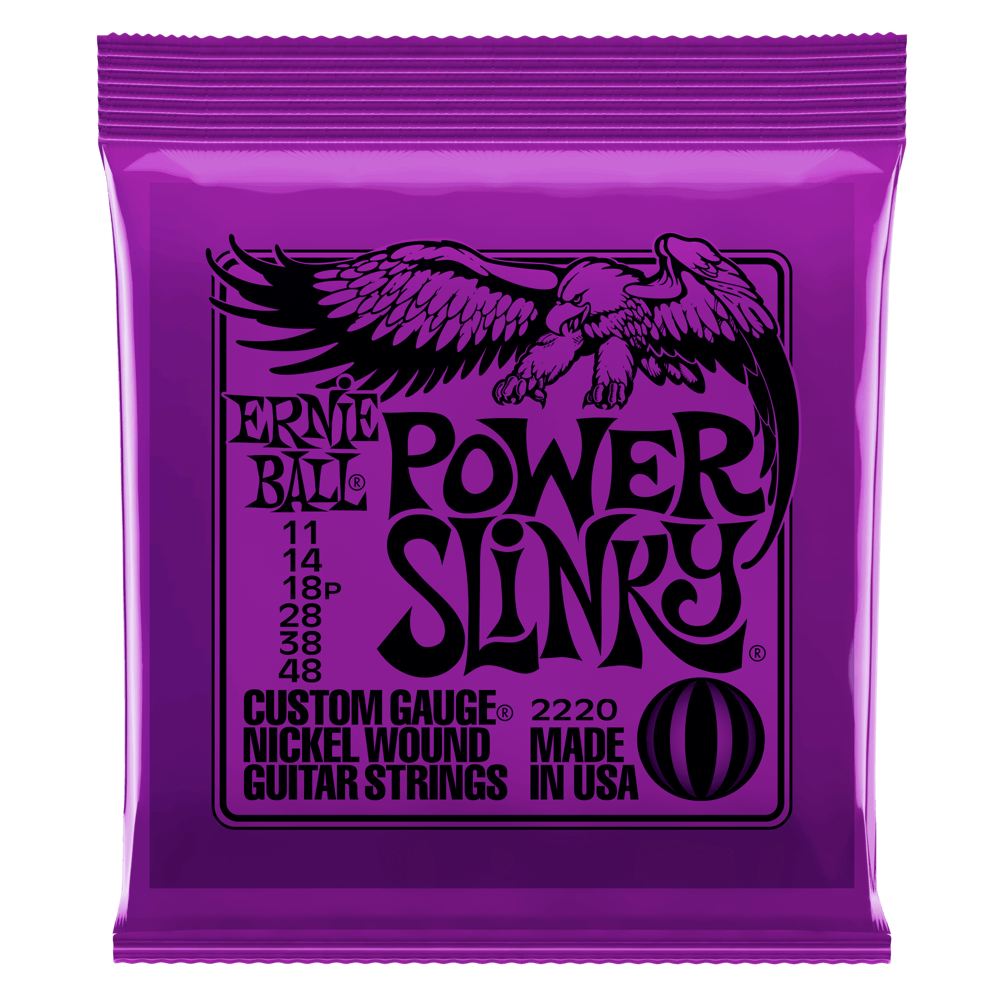
I'm using the .013 set of Ernie Ball Nickel Wound strings -- the pack with the eagle on it. I'm also sticking with the .013 and .017 in the set instead of opting for the slightly heavier replacement strings:

On my Fender guitar, a 1979 Lead I (though for some reason the serial number says it's a 1981), I actually used D'Addario Chromes flatwounds -- the .012 set -- for a long time. Way back in the past, I used .010 and .011 roundwound sets: Ernie Ball Slinkys, GHS Nickel Rockers (before I knew there was a difference between pure nickel and nickel-plated steel).
The .012 flatwounds were definitely too big for the nut on the lower couple of strings, though the extra tension didn't affect the neck at all. That 1970s Fender neck is a single piece of maple with no added fretboard and a skunk stripe behind it to cover the truss rod, and it's super strong. I have never needed to adjust the truss rod.
I wanted something slightly lighter. Strings that would fit in the nut slots without any filing, and a clearer, less-boomy, more defined low end.
I picked up a set of Ernie Ball Power Slinky strings, which start with a .011 high E and tend to run slightly lighter in the lower strings than the usual .011 set.
The strings have been great. Returning to roundwounds on both my Gibson and Fender is like I'm playing two new guitars. You can change your sound so much just by changing strings and picks -- two of the cheapest things in the guitar world.
Slinkys are nickel-plated steel, and I do have a set of this same gauge made with pure nickel windings called Slinky Classics. Pure nickel is supposed to be more subtle than nickel-plated steel. Maybe they'll sound better. But I like this current Ernie Ball Slinky set so much, I don't want to make the change.
I don't need a .052 or .054 for the low E (like Ernie Ball's Skinny Top Heavy Bottom and Beefy Slinkys), and this set is balanced very well for what I want.
Here's what the Ernie Ball set looks like:
My Yamaha flattop guitar -- it's probably 5 years old at this point -- has a solid top and is a "solid" guitar all around. It's put together very well and is pretty tough.
The guitar shipped with Yamaha's own custom-gauged set of .012s -- roughly equivalent to light-gauge strings. I think the strings were phosphor bronze, which tend to have a longer life.
I probably should have stuck with .012s when I changed the strings, but I decided to go up to a medium-gauge set that begins with a .013. I went for Ernie Ball Earthwood 80/20 bronze strings.
They sound amazing, and they're cheap enough that I don't mind changing them sooner.
This was my first time changing flattop strings. I've changed strings on electric and classical guitars hundreds of times -- I even do the thing where you tie the nylon strings to the bridge.
But bridge pins? I was a bridge pin virgin. I had the bridge-pin puller on the end of my string winder. One of the pins popped out with such force that it hit the ceiling. After that I made sure to block the path with my hand. I did have one of the pins edge out a bit after I tightened the string up. But I got it done.
I'm not a fan of bridge pins. It's just the tension of the pin and the angle of the string tension holding everything together. I'd prefer an archtop tailpiece. That I can deal with.
I also had to crank the truss rod quite a few turns after I replaced the .012s with .013s. I started with quarter turns, but I had to keep cranking and cranking, loosening the strings in between adjustments. I thing I have it right now. I got tired of cranking after awhile. It plays well and sounds great.
Here is my Ernie Ball Earthwood set:

So, what did I play today? I have been working on "How High the Moon," but today I worked on the chords for "Waltz for Debby." I'm very, very slow. That's what I'll say about it.S

I got a bottle of Dunlop Ultraglide 65 String Cleaner and Conditioner and tried it today on my flattop strings, which happen to be an 80/20 bronze set from the Ernie Ball Earthwood line. The strings are not the most resistant to dirt and corrosion, and they are nowhere near so far gone that they need changing but weren't exactly out-of-the-package new.
The Dunlop 65 appears to be a very lemony oil, and it easily went on the strings with the spongy applicator, after which I wiped off the excess
The strings were cleaner, and a lot smoother. I definitely recommend this stuff. Clean strings aren't the worst thing, and this stuff makes it easy.
Back in the day I used to use rubbing alcohol to clean my strings. That can be drying, to say the least, if you get any on the wood of the neck, and it certainly doesn't make the strings feel smooth. This stuff from Dunlop is a lot better.
A bottle costs somewhere between $5 and $7 -- about the price of a set of strings. It's worth it.
I manage a CentOS 6 server, and I have a request to replace PHP 5 with PHP 7.
Here is a solid and mercifully brief tutorial on how to do it.
I was wondering how IFTTT makes money. They are certainly not shoving a subscription model down anybody's throat.
Quora user Aaron Disibio says that aside from all the investor money they have been getting, they have a paid Partner Platform.
This is a test of IFTTT blog entry posting.
I now have two IFTTT applets, one to post on Twitter ONLY from my blog's dedicated "social" directory (posting the post body instead of title and URL) and another to post to Twitter from everywhere BUT my "social" directory (posting the traditional title and URL).
The social posting applet was easy to create -- and I probably did this very thing when I was looking at IFTTT a couple of years ago when I started creating social posts in the /updates directory of my blog. It was the other applet -- the one that excluded a single subdirectory (or WordPress tag or category, both of which are represented as a subdirectory in RSS).
Dlvr.it made this easy. There is a field for it.
For IFTTT, I hacked together some quick TypeScript to filter out what I didn't want.
Is it working? I'm still testing the applets, and I'll have to add a bit more code and explanation before I make them public. I'm already thinking (in my brain) about how to boil them both into a single IFTTT applet, which is a lot more elegant than having two.
Now I remember: One of the reasons I chose dlvr.it over IFTTT when I first implemented these automatic social poposts in 2015 was that in-text links from dlvr.it displayed with their text, while the same links over IFTTT displaed with shortcode text, which can make the post unintelligible because the text that carries the link can be kind of important.
Update: My TypeScript/JavaScript isn't working.
Current time in UTC
Categories
Counter
There are 865 entries in this blog.
There are 294 images in the filesystem, 187 of which appear in actual posts.
Syntax highlighting
I am using Highlight.js for syntax highlighting.
Social updates
As I say at the top of this site, my social-style entries are posted to a separate Ode blog instance at updates.passthejoe.net. The Ruby script I use to do this is pretty ugly, but I released it on Github anyway. I started working on a version that is much more class-based (as in object-oriented), but that project stalled out a bit. I'm considering bringing this concept to Android, or doing it in Java with a JavaFX GUI, or doing it in Node.js for JavaScript practice.
Archive
The archive is not up to date due to the 2020 hosting migration. I plan to work on it.
Hello, world — this is my website
No databases were harmed in the making of this blog
You're seeing this blog, powered by Ode, through the magic of the Perl programming language and the Common Gateway Interface. Also involved: the Apache web server and Linux operating system.
Ode does not use a database to store content. Instead, every entry exists on the web server as a "flat" text file.
Comments are managed via Disqus, integrated through the work of Ode project leader Rob Reed.
Counter and categories: Thanks to Rob Reed for his help on the Counter addin, which provides the post-count and category features seen above. The show/hide feature is coded with inline JavaScript.
E-mail: stevenhrosenberg@gmail.com.
Who am I
and why am I here?
My name is Steven Rosenberg. Journalist. Programmer. Husband. Father. Fixer of the broken.
License
CC BY-NC-SA

Frugal technology, simple living and guerrilla large-appliance repair by Steven Rosenberg is licensed under a Creative Commons Attribution-NonCommercial-ShareAlike 4.0 International License.
Archives
By year and month
Links
My sites
- RSS of this blog
- Microblog of short posts
- Steven Rosenberg (WordPress)
- Click
- Come on Feel the Nuys
- Steven Rosenberg on Twitter
Ode sites
I support the open web
Powered by
