
Regular blog here, 'microblog' there
Many of my traditional blog post live on this site, but a great majority of my social-style posts can be found on my much-busier microbloging site at updates.passthejoe.net. It's busier because my BlogPoster "microblogging" script generates short, Twitter-style posts from the Linux or Windows (or anywhere you can run Ruby with too many Gems) command line, uploads them to the web server and send them out on my Twitter and Mastodon feeds.
I used to post to this blog via scripts and Unix/Linux utilities (curl and Unison) that helped me mirror the files locally and on the server. Since this site recently moved hosts, none of that is set up. I'm just using SFTP and SSH to write posts and manage the site.
Disqus comments are not live just yet because I'm not sure about what I'm going to do for the domain on this site. I'll probably restore the old domain at first just to have some continuity, but for now I like using the "free" domain from this site's new host, NearlyFreeSpeech.net.
Do search and social-media links to content tucked behind paywalls represent a form of bait-and-switch, "tricking" users of those services into clicking links for content they cannot see without a subscription or paying a one-time fee?
Do words like (nonfree), (fee to read) or (subscribers only) make it more acceptable to promote non-universally available content via search engines like Google and social-media sites like Twitter and Facebook?
My quick answer is that creators of content are able to use the "open" Internet network to distribute their content and restrict access via software. It's a form of privacy.
But I do not like when links to that content appear on my social-media feeds without a warning that the content isn't accessible with payment. Give me an appropriate warning about the nature of the transaction ($ for content) and I can decide whether to click, ignore or remove from my feed altogether.

After years of using flatwounds (generally D'Addario Chromes beginning with a .012) on my Fender Lead I guitar, I decided to go light(er) and roundwound with a set of Ernie Ball Power Slinky nickel-wound strings (.011, .014, .018p, .028, .038, .048).
And I'm liking the sound and playability very much. While I like the feel of really heavy strings (I use D'Addario Chromes, the .013 set, with an .014 subbed for the high E and a .018 for the B string), I think those strings overwhelm the solidbody Fender guitar. Or least that's how I feel for the way I play it.
I really like the plain 3rd string, which contributes to the overall evenness of volume and tone.
 Even with only a bridge humbucking pickup, the Lead I has a very wide tonal range, and I can easily dial in a good jazz sound.
So much depends on the way you have everything set up -- the knobs on the amp and guitar, the way you play it. I generally use a heavier touch and keep the volume lower.
As I say above, I've gravitated to really heavy strings, but now I'm thinking differently, and I really like this Ernie Ball set. The lower strings, and the low end of the instrument in general, have a lot less muddiness (and a lot more definition).
The guitar, which I've had since I bought it new in what I think was 1979 (but the serial number indicates 1980) is a nice, heavy instrument.
I've pondered "converting" it to a Lead II with two single-coil pickups. I even have a Lead II pickguard ready to go, but I've just never gotten around to that mod (I would need the pickups, pots and tone capacitor, and then I'd have to figure out the wiring).
 I'm using the orange Roland Cube 60 amp that, like pretty much every electric guitar I've ever had, I purchased when I was in high school.
About the only guitar I've "let go" over the years was the nice handmade classical that I used during my time in the music program at CSUN. I can't even remember the name of the company, but it was a nice guitar. It had a cedar top -- you could really smell it. I'm more of a spruce-top person, so I'm not all that sorry I don't have it, but it was a very, very nice instrument, and I think I'd enjoy playing a well-made classical guitar built with really good wood.
Takeaway: Players of different kinds of music on the guitar think that they need a certain type of instrument, strings and amplifier to credibly make a certain kind of music. For jazz that seems to be an archtop guitar, heavy flatwound string and amps with a whole lot of headroom so you don't have to drive it too hard to get the volume you need. While I agree with the amp requirement, and I absolutely love the sound of an archtop guitar (both electric and acoustic), when it comes to strings (light, heavy, flatwound, roundwound) and even type of guitar (solidbody, flattop, classical, full archtop, archtop with bridge in a block of wood), there are plenty of viable, sonically rich options.
Note: The Ernie Ball strings image came from the Musician's Friend site. I used an iPod Touch to take the Fender Lead I and Roland Cube 60 photos. The sweet case that Ilene sewed for the iPod Touch can be seen next to the guitar.
I like options. And contingency plans.
So I've been adding development tools to my Windows partition (currently stuck on Windows 8 since the 8.1 upgrade won't play nicely with my Win 8/Fedora dual boot).
I upgraded Strawberry Perl, added Ruby and Node, made sure I had the full JDK 8 and removed an older version of Python. I downloaded a new Python but haven't installed it yet (mostly because I'm not using Python at the moment).
I also have Netbeans ready to install, and I'm thinking of giving Geany a try in Windows. I use it a lot, especially these days for Java because I can compile and run in the editor. Otherwise I use Notepad++ for my editing.
I don't have everything working on this side, but I can certainly mess around with Perl, Ruby, Java and JavaScript. I know I could get a full Linux command line environment with Cygwin, and while I'm not yet ready to say that defeats one purpose or other, it's not something I'm considering at this particular moment.
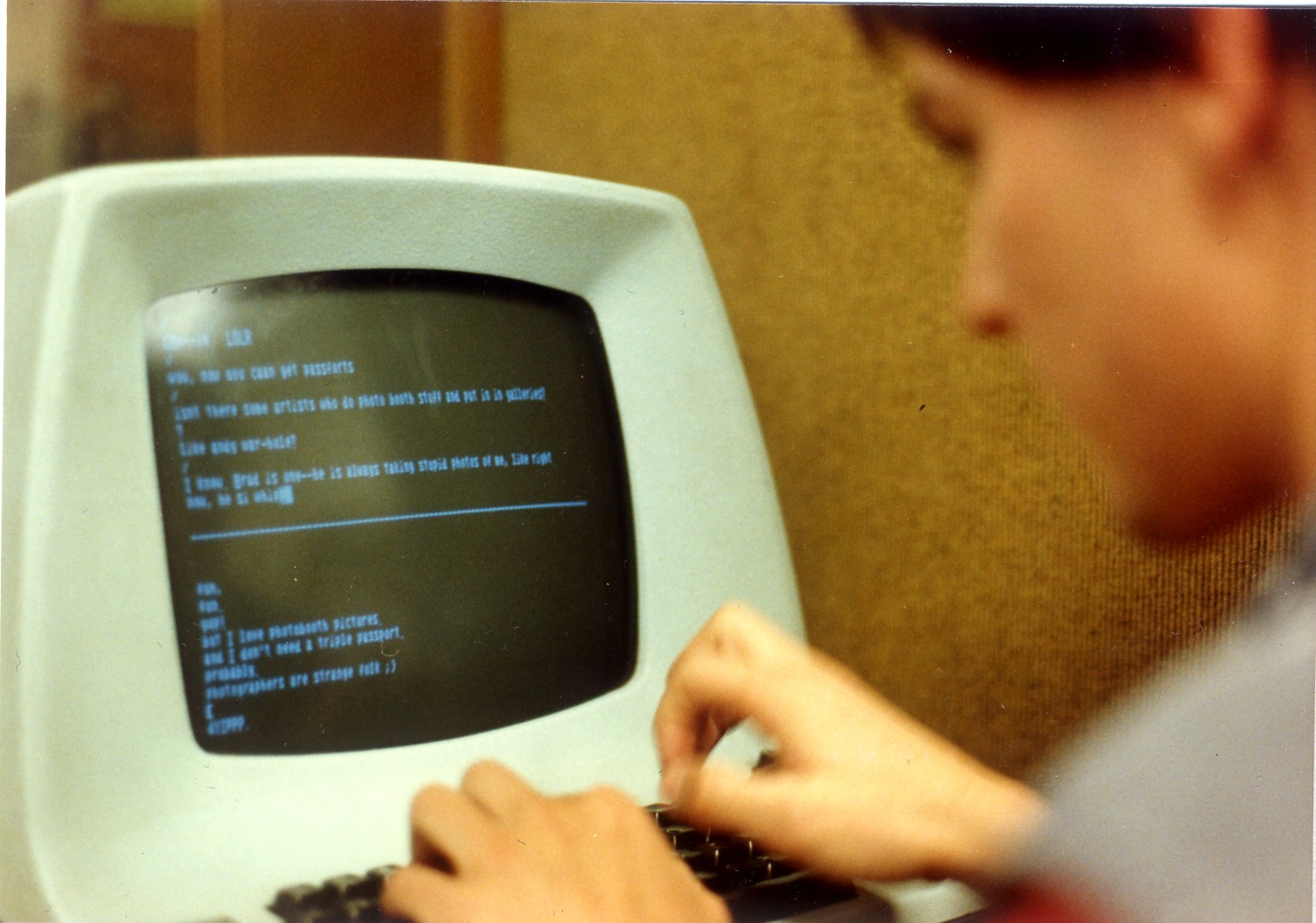
That's me on an ADM-3A terminal at UC Santa Cruz some time in the late '80s. I'm using whatever version of Unix the university had at the time. I can see from the screen that I'm running the talk program with one of my friends on UCSC's Unix B system.
Unlike the other Unix machines (all named with various letters), Unix B was open to anybody who wanted to start an account.
With the help of a photocopied manual called "Unix for Luddites,"available for a couple bucks at the campus' Bay Tree Bookstore, you could learn vi for writing, nroff for formatting and a smattering of shell commands to get your papers printed on a mysterious, before-its-time laser printer somewhere deep in the campus computer center. Your work would eventually end up in cubby holes for later pickup.
While the ADM-3A was the coolest, most retro-looking terminal, even back then you were a little lucky if a DEC VT100 (or similar) was available. Its screen was green and clearer, its keyboard less mushy.
You were really lucky if one of the even-newer Wyse (unsure of model numbers) terminals was in your college's computer room (or the college next to yours; though a Porter student, I gravitated toward Kresge's much better computer lab/room). The Wyse terminals had amber screens that were even clearer than those of the DECs and (more importantly) featured nice, clicky keyboards.
But for sheer design, the ADM-3A was (and is) a classic.
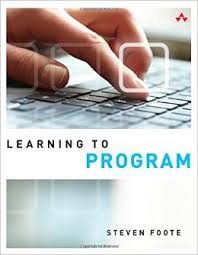
I am reading "Learning to Program," by Steven Foote, an introductory programming guide focused on JavaScript with a novel twist: Lessons are taught through the creation of Google Chrome browser extensions.
I'm only on Chapter 2, but things I already like about the book: It's for beginners but doesn't act like Node.js isn't a thing, I really like the idea of creating browser extensions, and it looks like it goes through a good number of programming concepts.
And Mr. Foote's writing style is clear and inviting.
I stumbled upon the Fedora Developer Portal via a link from Reddit that actually first took me to the Deploy and Distribute page, which offers overviews on how to create RPM packages and create/use a COPR repository. Then there's the Tools page on DevAssistant, Vagrant and Docker, and the Languages & Databases page to help you get your development environment together.
And this only scratches the surface of what you can do in Fedora (and other Linux operating systems such as Debian and Ubuntu).
I guess I'm a developer in that I write code sometimes, and Fedora is a great way to get a whole lot of fairly up-to-date tools without having to chase down updates from individual projects.
Fedora is developer-centric. That's what people use it for. So if that "bias" works for you (and it does for me), Fedora is a great way to go.
Note on Fedora Workstation: While I do have all of the Fedora Workstation packages on my system and can run its GNOME 3 desktop environment whenever I get the urge, I find that the Xfce desktop environment fits better for what I do both professionally and otherwise with this computer. You can get Xfce on any Fedora system via the package manager, or install it directly with the Xfce Spin.
Like anybody who uses Linux (or any other system) for a length of time, I have applications and configurations that I prefer, though the Fedora Xfce Spin is a great place to start.
Hey Linux users, are you using GNOME Tweak Tool to choose the "Dark" theme, making your GTK3 applications dark and causing problems with white-on-white text in the Firefox browser?
I have. Even though I almost never use GNOME 3, I do have it installed, and the GNOME Tweak Tool's "dark theme" switch enables me to turn GTK3 applications like Firefox "dark" in their styling. Except that often you can't read text boxes on web sites because the "dark" theme turns the text white while also leaving the background white.
Can you see this word?
Here it is with backticks:
Here it is on a line with backticks:
Can you see the ?
It begins as a dollar sign: $
Here it is as a code block set off by a tab/indent:
And here it is at the beginning of a line with backticks:
I imagine this is a potential problem because of the way Ode passes data from the script to the HTML.
My question: Is there a way to "escape" the $ so it appears on the live Ode site without resorting to backticks?
It seems that I can get a single $ but not a with backticks.
See the markup: Here is this file as plain text.
I try to switch to dark themes on as many parts of my computing workflow as possible.
The desktop environment, my applications -- I try to make it all dark.
Why? It's easy on the eyes.
I'll go into my full dark-theme setup later, but for now I'd like to share my discovery of the dark themes in the Geany text editor.
I didn't think Geany had themes, let alone dark themes. Turns out it has both.
And I've been using Geany a whole lot because a) copy/paste of text with Windows-style line endings is broken in Gedit (it comes out Unix style) and b) I'm using Geany to work on my Java code because it will compile and run it right in the editor.
I found a link to the Geany Themes site on GitHub. I downloaded the whole thing as a .zip file (I probably should just use git to fork it onto my local drive), then dropped the colorschemes directory into my own ~/.config/geany directory (making it ~/.config/geany/colorschemes) and then in Geany I could choose a Color Scheme under View - Change Color Scheme in the application's menu.
Right now I using the Monokai color scheme.
All I need to do now is figure out how to execute either a Perl or Go program and get the output into the editor (like I do with Gedit Snippets), and I can use Geany instead of Gedit to write this blog's entries, which include a script-generated timestamp for Ode's Indexette add-in.
Update: It is possible to insert a custom-formatted date into your file in Geany under Edit - Insert Date - Use Custom Date Format, using Edit - Insert Date - Set Custom Date Format to set it. For my Ode datestamp I used tag : Indexette : index-date : %Y %m %d %T. Unfortunately it outputs the date in my local timezone instead of UTC, which is what I use in my Ode site. I don't see any way of making the "Custom Date Format" output UTC, so this makes Geany that much less useful for the purpose of writing for Ode.
I tried the Mini-Script plugin, but that is cumbersome, and I even overwrote one of my scripts on accident because of its less-than-ideal user interface.
In short, there's nothing in Geany like Gedit's Snippets plugin, which is ideal (and makes Gedit itself ideal) for writing Ode entries.
I had a problem in Fedora 22 where switching the audio between the laptop's own audio and HDMI audio using the PulseAudio Volume Control (aka pavucontrol) mutes the audio out of HDMI until logging out and back in.
Now that problem has been solved. I don't know how. I don't know which package is responsible. But what was once an annoying bug is a problem no longer. Audio switching via the pavucontrol is perfect.
That's what happens with Fedora 22. Sometimes you have a regression, or something never worked at all. Eventually there are improvements and bug fixes in any number of upstream packages, from the kernel on down, that stand a good chance of making those bugs go away and bringing needed (and wanted) improvements.
Current time in UTC
Categories
Counter
There are 865 entries in this blog.
There are 294 images in the filesystem, 187 of which appear in actual posts.
Syntax highlighting
I am using Highlight.js for syntax highlighting.
Social updates
As I say at the top of this site, my social-style entries are posted to a separate Ode blog instance at updates.passthejoe.net. The Ruby script I use to do this is pretty ugly, but I released it on Github anyway. I started working on a version that is much more class-based (as in object-oriented), but that project stalled out a bit. I'm considering bringing this concept to Android, or doing it in Java with a JavaFX GUI, or doing it in Node.js for JavaScript practice.
Archive
The archive is not up to date due to the 2020 hosting migration. I plan to work on it.
Hello, world — this is my website
No databases were harmed in the making of this blog
You're seeing this blog, powered by Ode, through the magic of the Perl programming language and the Common Gateway Interface. Also involved: the Apache web server and Linux operating system.
Ode does not use a database to store content. Instead, every entry exists on the web server as a "flat" text file.
Comments are managed via Disqus, integrated through the work of Ode project leader Rob Reed.
Counter and categories: Thanks to Rob Reed for his help on the Counter addin, which provides the post-count and category features seen above. The show/hide feature is coded with inline JavaScript.
E-mail: stevenhrosenberg@gmail.com.
Who am I
and why am I here?
My name is Steven Rosenberg. Journalist. Programmer. Husband. Father. Fixer of the broken.
License
CC BY-NC-SA

Frugal technology, simple living and guerrilla large-appliance repair by Steven Rosenberg is licensed under a Creative Commons Attribution-NonCommercial-ShareAlike 4.0 International License.
Archives
By year and month
Links
My sites
- RSS of this blog
- Microblog of short posts
- Steven Rosenberg (WordPress)
- Click
- Come on Feel the Nuys
- Steven Rosenberg on Twitter
Ode sites
I support the open web
Powered by
